I’ve thought a bit about package management and prototyped sc-deken, a cross-platform package manager for SuperCollider with a supercollider UI that handles both server plugins (UGens) and quarks in one searchable window. Plugins come pre-built for some platforms and supercollider API versions but can also be built locally on your system for other combinations.
Why yet another package manager?
- Quarks work well for sclang code but it clones git repositories and has no concept of per-platform binaries. Compiled UGens are not a good fit for the system.
- sc3-plugins ships binaries as one big bundle on its own release schedule. The monolitic sc3-plugins repository causes some maintenance burden.
- Mads Kjeldgaard’s plugins.quark (GitHub - madskjeldgaard/plugins.quark: A package manager for SuperCollider plugins · GitHub) made for a good start: a curated directory of UGens with a Quarks-style GUI that downloads and compiles them for you. There were some drawbacks: It offers no pre-built binaries so every install is a build. It only handles plugins, not quarks. The recipes in plugins.quark are executable code, which I didn’t particularly enjoy.
- Pure Data’s deken, which inspired the name, shows how pleasant ready-made binaries can be, but there the authors build and upload packages themselves, which nowadays causes security concerns.
- There was no mechanism yet to warn users about problematic packages (e.g. badly broken or containing malware).
sc-deken tries to take the best of many worlds:
- Quarks-style UI in supercollider. Screenshot
- Recipes for builds are plain data reviewed in a public repository.
- Binaries are built by trusted tools (GitHub CI) from approved commits, not uploaded by individuals.
- The package list is signed, and every download is checked against its checksum.
- When no binary exists, it falls back to a guided local build, much like plugins.quark.
- It doesn’t replace Quarks: quark installs go through SuperCollider’s own Quarks code.
- Easy to use, easy to suggest missing packages from the UI (but they are not automatically added until appoved by a human reviewer).
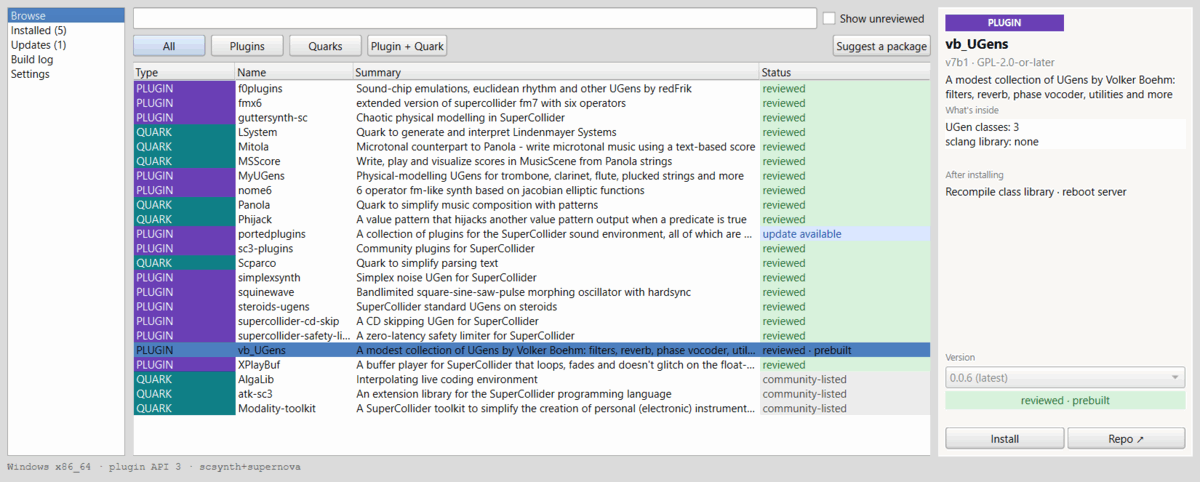
Features
- Unifies searching, installation and management of Quarks (with their dependencies) and plugins (and hybrids), the code of which is individually maintained in many scattered repositories.
- Search by name, summary or UGen name. Type “FM7” and it finds sc3-plugins. Building and updating the search index is fully automated and stored on github.
- Prebuilt downloads for Windows, macOS (universal) and Linux (x86_64 and arm64), built by GitHub CI. You don’t need a compiler on standard platforms. (Note: I cannot sign binaries, this is a functional proof of concept).
- Build and install on your own computer if no download exists. The user interface should tell you which tools are missing on your system to do the build, and how to install them.
- Updates, and warns when a package is withdrawn (e.g. malware or broken). Nothing is deleted from your computer without asking: replaced copies go to a backup folder, removed ones to quarantine, renamed so they cannot be loaded “by accident” if the backup folder is added to the supercollider search path.
- Everything is scriptable: Deken.search(“fm”), Deken.install(\portedplugins), Deken.update(…).
- Maintenance is minimized: github automatically scans for new tags in the tracked quarks/plugins and creates pull requests to update the list. Search index is automatically built and kept up to date. Pull requests for adding or modifying packages (recipes) does need to be approved explicitly by a maintainer.
The list has about 390 packages today: 25 reviewed by hand, 310 from the official quarks directory, and the rest some unreviewed ones found on GitHub.
Unreviewed packages are hidden by default, and installing one asks you first, naming the repository and commit that would be built.
Is your favourite package missing?
The “Suggest a package” button opens a short form. You fill it in and automatically a pull request is created.
These pull requests must be reviewed and merged manually to reduce the risk of adding spam and malware.
To try it (SuperCollider 3.13+, for now tested only on windows and linux as I don’t have a Mac):
// in scide
Quarks.install("https://github.com/shimpe/scdeken"); thisProcess.recompile;
// after the recompile:
Deken.gui;