It’s a good question. I’d like to see more conversation about music here.
Your direct question is, “Why do you think it isn’t selling?” The simplest answer, of course, is that experimental music generally doesn’t sell that well, no matter how good it is.
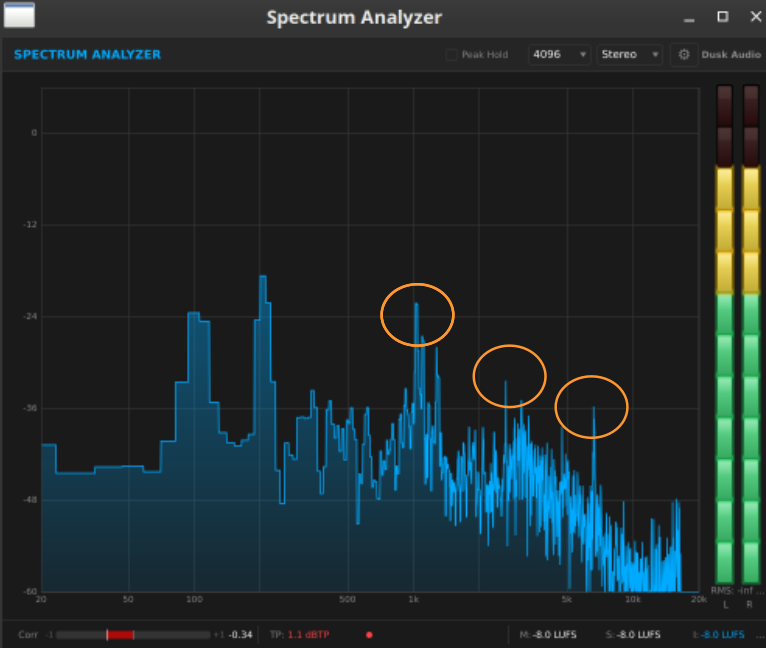
More specifically, this is a fairly long track, without much textural variety, which also leans heavily into mid-high and high frequency noisy sounds. Midway through, I started running it through a spectrum analyzer; some peaks in problematic frequency zones are easy to spot.
Now, sure, I can imagine reasons to make music with this kind of harshness, and I can understand that the length is necessary perhaps to encourage the listener to let go of expectations (to roll with the sounds as they are coming) or perhaps to overwhelm the listener’s defenses.
With that said (and sorry to say), it’s quite physically uncomfortable. By comparison, I used to listen to my fair share of Autechre. There are a couple of things they do differently to make it more ear-friendly (I mean in physical terms, not necessarily musical style terms). One thing is the balance between mids and highs: highs for color, mids for support. Distortion in their hands is crunchy without shrieking. Another is that the high frequencies are often involved in articulating rhythm, meaning that the highs aren’t continuous piercing drones, but rather have a lot of movement and a lot of internal starting and stopping. The ear gets frequent micro-breaks. Sometimes they let the highs pause for a little while, again, to let the ear rest.
It reminds me of a few years ago when I was mixing recorded tracks from my electronic ensemble class. There was one mid-range drone that was drilling into my ears – I felt really fatigued after working on the mix for 40-50 minutes. I was struggling with EQ, anything to make that drone settle down. Then one of my colleagues suggested simple automation. That worked brilliantly. I could bring this drone to the foreground, then after a minute or two, reduce its volume and push it into the background of the mix. This allowed other parts to come forward without crowding the mix. Just changing the balance occasionally introduced a variety of texture that made the entire listening experience feel more balanced and pleasant. Technically very simple; huge difference in impact.
Just the other day I saw a friend’s name on a Facebook thread about whether composers should or shouldn’t consider the audience. I do consider the audience – not in the cheap way of trying to guess what they want to hear and pandering to that, but more in the sense of, what will the audience take away from this? What do they need to hear that maybe they’re not aware of right now? Which sounds will lift them up to a better state of mind, and how to deploy those over time? Then, compositional and audio generation algorithms are used in service to the answers to these questions. (Music is primarily a relationship, and only secondarily a product. Unfortunately many composition programs implicitly teach students to view the audience as a passive recipient, i.e., that “my idea” as a composer reigns supreme and the audience’s relationship to that is one of submission. I’ve come to feel that a more respectful view of the audience is what works better for me.)
hjh