LLM appreciation/rant thread

Damn, that’s pretty bleak.

why should anyone bother w/ a high level language if people stop coding?

Actually, I don’t think that everybody will stop coding. Don’t forget that many, if not most, SC users do not have a background in software developement. For them sclang is their first and only language. They don’t think of themselves as programmers, sclang is just a tool for creating music. Yes, writing code by hand might seem antiquated to professional software engineers, but artists use all sorts of seemingly old-fashioned tools.

I think the question regarding supercollider: should we start letting agents walk over the codebase and introduce features that would be actually great, or should we keep a more slow-paced approach as-is, where we give people a chance to develop things - but then again, who would be interested in these features if everything is just given?

There has been so much software, even before AI, but only a few stand the test of time. IMO SuperCollider is one of them. There is simply no reason for “moving fast”. We are not a startup, we are maintaing an almost 25-year old program.

My personal coping strategy is to ignore most of the hype, keep doing my thing and see how it plays out in the next few years :slight_smile:

B/c r/n we still follow the policy everything has to be understood by the person who submitted a patch.

That’s how I would like to keep it :slight_smile:

7 Likes

My personal coping strategy is to try and ignore the hype, avoid people who use AI and to remember. None of the stuff that is happening right now (including free Chinese AI models) is remotely sustainable, which means most of it will not be around in a couple of years.

Also, people get satisfaction from knitting. Just because an AI can do something ‘better’, doesn’t mean you have to use it. A Kayak is way slower than a speed boat, but somehow Kayaks are still with us.

4 Likes

A professional programmer with more than 40 years of experience told me that AI writes better code than he does based on his tests. I think such high-skilled persons would use another level of prompts than most individuals, who get convoluted code from AIs due to having just some basic programming skills or not having any experience.

AI-generated code can be imperfect and may contain many issues. However, if the code successfully serves its intended purpose, some of those issues seem not to matter. In many personal projects, achieving the desired result can be more important than producing perfectly optimised code in terms of logic, CPU usage, or memory efficiency.

I think for personal use, such code may be perfectly acceptable. For example, in concerts or live performances, inefficient code may not be a serious problem if it works reliably and is never exposed to others.

Once the code is shared, however, it becomes open to criticism. In academic work and open-source development, well-structured code is important, and ideally the author should understand both the implementation and the underlying logic, regardless of whether the code was written by a human, generated by AI, or created through a combination of both. In purely personal projects, by contrast, code structure may be less important.

However, coding is only one application of AI. More important than the code itself is what people can actually accomplish with it. Code can often remain hidden, whereas many other AI-generated outputs are directly exposed to an audience: text, music, images, videos, and so on.

Here is an example.

Yesterday, I tried using NotebookLM to generate a video explaining a quiz for my students. I attempted it more than ten times but eventually gave up. No matter how specific my prompts were, the video generator continued to make its own creative decisions. Some parts were acceptable, and a few parts were even quite good, but every version contained sections that made the overall result unusable.

For me, AI is most useful at the beginning of a project. It is excellent for exploration and rapid prototyping. However, I still do not fully trust it for finalisation or automation. Even when given concrete instructions, it often produces results that diverge from the intended goal because of hallucinations or misunderstandings of context. Fixing those problems takes an enormous amount of time and energy. After a while, I find myself endlessly correcting small details, and often I feel more like a machine than a human.

My most frequent use of AI is correcting my English and occasionally translating my writing into English. I accept the suggestions that seem appropriate to me, but my judgement is imperfect because I am not a native English speaker. When I use AI to translate texts from other languages into Korean, I still encounter many unnatural expressions and contextual misunderstandings. AI technology has improved remarkably quickly, but I believe that human judgement remains essential.

(The entire text is an AI-corrected version of a text I originally wrote in English, with the suggestions I chose to accept. It still took me about two hours of reviewing, revising, and second-guessing everything.)

2 Likes

I’m finding it very easy to get sucked into other people’s predictions, where the problem is, we have no precedent for any of this. One person says “99% unemployment”; another says “it’s a bubble and it’s going to crash soon.” AGI is “a year away” or “never coming because LLMs are not it,” and on and on.

What’s known is that the big companies are losing cash, fast, while using investment capital to subsidize usage fees far below the operating cost (because they know the vast majority of users will not pay several thousands per month for what they’re getting, including small businesses who made business plans around $200/mo “because everybody’s going to get rich off of AI” and which will be wiped out if their usage-based cost goes up to $10,000/mo), and hiding all of this by shuffling mutual investments amongst themselves. That’s all known. So the assumption on the pro-AI side is that the LLMs will get smart enough to make themselves profitable before the mutual investment scam collapses. Will they? I dunno. We still haven’t seen the predicted degradation that is likely to follow when models start training on other models’ output, for one thing.

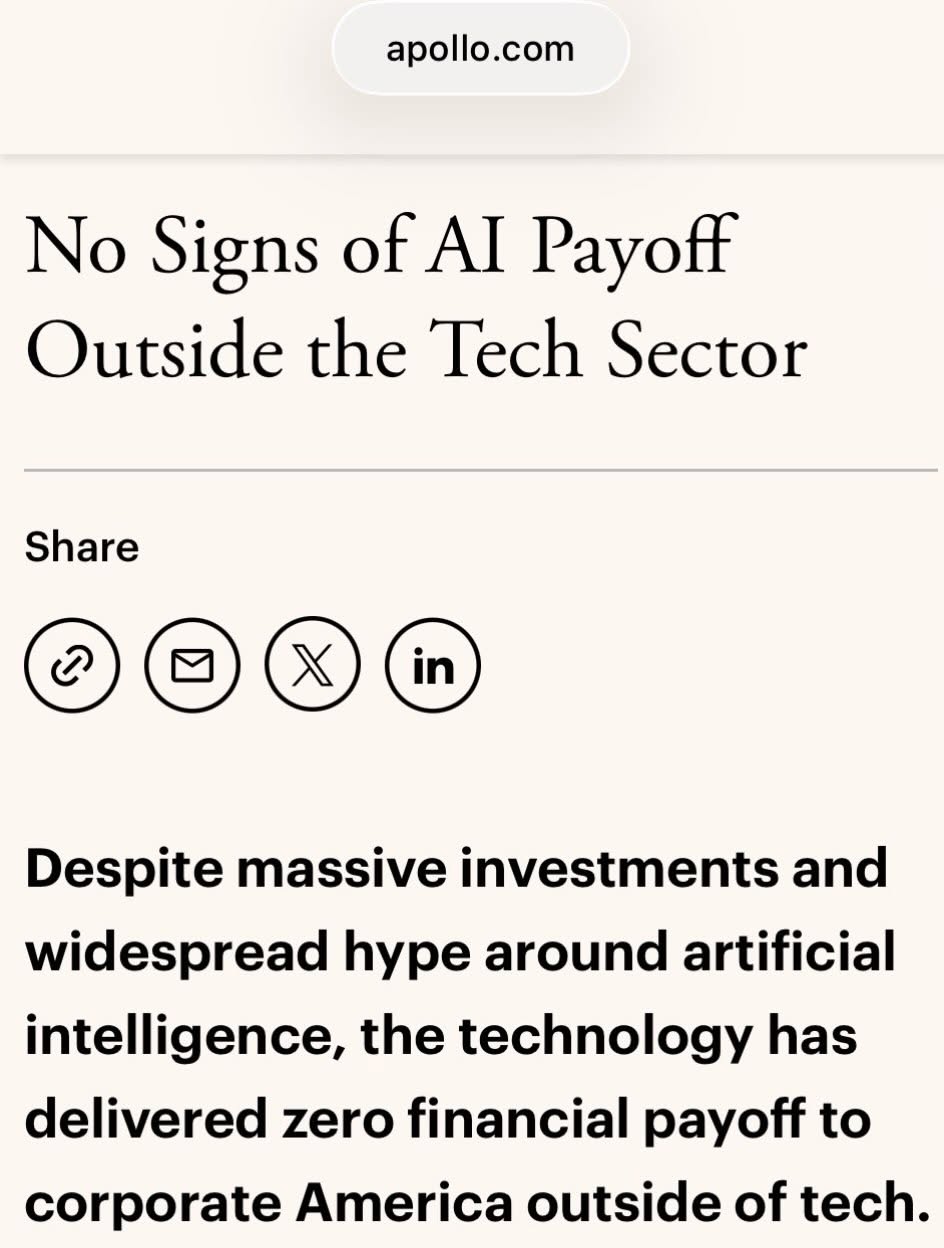
What’s also becoming clear is that the immense amount of investment and effort going into the training of language models that are good at programming has produced language models that are not good at anything other than programming :laughing: as investment firm Apollo just stated publicly.

hjh

2 Likes

…and this effort has great value - I am delighted to have been able to be a tiny part of it (mainly as a cheerleader) - and I am very grateful to you and the other talented people who have been doing the work. I don’t think the agents’ utility changes that in any way.

Agents do effective work near the median of what has been written already. The whole corpus can not grow in quality without work far from the median - that is for us to contribute. Where we don’t need creativity, or where we do need sheer brute force, we can optionally leverage our efforts with these tools.

Re: corporations, AI is a capital intensive commodity product - there is no moat and my guess is that it may never make a ton of money, like airlines for example. If we want the flexibility to withdraw from using it we do need to continue to understand our code.

@Spacechild1 made the important point that people make music with all kinds of retro means - guitar! Maybe SC is actually even more precious in this moment?

2 Likes

So the assumption on the pro-AI side is that the LLMs will get smart enough to make themselves profitable before the mutual investment scam collapses.

It’s actually worse than that. The bet is that they will not only be profitable, but so profitable that they’re several orders of magnitude larger than the entire software industry. If your fire a rock into the sky it will come down. The question is will it come down relatively harmlessly (destroying only the rock), or will it hit a city. Same with the current AI industry - there’s no way it can survive. It’s more a question of how much fallout there will be. I think a fairly plausible outcome is that in 2-3 years Nvidia will no longer exist (except as the story of a scandalous fraud, a la Enron), and the easiest way to get thrown out of a bank/boardroom will be to bring up AI.

That’s not to say that AI will fail, or won’t change things (for good and ill), just it won’t look much like what we’re currently seeing. Because what we’re currently seeing is unsustainable, and the rock always hits the ground eventually. Maybe something smaller and cheaper will replace Claude - who knows - but I’d be very surprised if Claude still exists at the end of all this.

@semiquaver

Re: corporations, AI is a capital intensive commodity product - there is no moat and my guess is that it may never make a ton of money, like airlines for example. If we want the flexibility to withdraw from using it we do need to continue to understand our code.

Except airlines are fairly light on capital. It’s closer to heavily capital intensive industries like chip manufacture and mining. If you were to pick the absolute worst business to invest in - it would probably look like ‘AI’. The reason that nuclear failed wasn’t because it was a bad technology, or even because of safety concerns. It was because it’s just too damn expensive, despite all the many advantages. It’s not enough to have a good technology, it has to be affordable.

1 Like

I’m not using AI for this text, just a simple translator for some parts to help me out. I don’t even do this all the time, but since I want to write a bit more here than just a few sentences in my poor English, I’m using it. But I think you can clearly see my quirks and such in my writing style…

How do I use AI? I started with SC a few months or year ago, and at first I thought AI might be able to help me a little in the beginning. I also used AI for translation in this time. After a few months, though, I realized that I didn’t want a single line of code, idea, or thought from an AI in any form in my SC code or my work.
This thought bothered me so much (and still does today) that I radically deleted all my SC code from my computer, regardless of whether it was written by me or partly by the AI, since I could no longer say for sure. It was a complete code wipe.
I spent several weeks rewriting everything (ideas i had realized so far), and I mean absolutely everything I had coded up to that point, from scratch and without AI, also not for searching! After I completely rewrote my ideas, everything was better, much better in terms of functionality, clearer, simpler, and more appealing. That was the best decision I made this year. (Or in my artist life maybe? :wink:)

Since that day, I’ve used AI, if at all, exclusively as a better search engine. And even when searching with an AI, I stick to very strict rules. I don’t want code examples or solutions in the AI’s responses, just a link that might lead me to a solution in an SC Helper or a forum post. That way, I make sure I know where to look, but nothing from the AI ends up in my code. And sometimes an AI simply doesn’t understand even the simplest rules I clearly state and outputs a code example, in that case, I ignore it and delete the chat.

This all sounds maybe extreme, but now I can say that what I create comes EXCLUSIVELY from me, and that is important to me. Lately, I’ve implemented many complete plugins, complicated hardware synthesizers and effects, physical modeling, and more complex functions all by myself in SC, and to be honest, I’m absolutely proud, and sometimes they even work better than the hardware or their proprietary counterparts.

Many might consider this extreme, but I need this strict boundary for my well-being as an artist and human being.

And as a die-hard FOSS fan and supporter, I am extremely concerned that in some cases so much AI is being used in the code of our software, especially without thorough reviews.

I’m relatively new to SC, just at a time when questions are arising about whether we should even be creating art, mostly digital anymore. I say: Yes, absolutely. It’s important that we don’t let ourselves get discouraged.

And one more thought on SC code versus the finished music: In my opinion, when you code a synth, an effect, or anything else in SC that influences the signal, it’s just as much a part of the music and your art as the music endresult itself.
But for me personally, every single number or letter in the code, whether it’s just for a list, a GUI, or whatever, comes from me, even if it has absolutely nothing to do with the signal.

In closing, I’d like to say thank you for this thread, it gave me the chance to get this off my chest. And if that’s too extreme for some people, I still hope we can stay friends :grinning:

6 Likes

Side question, but what resources did you use to learn physical modeling? Or was this something you already understood.

1 Like

AI can only replicate combinations of coding that humans have done before. That is massively useful, but not creative. Creative NEW solutions are form coders and Computer Scientists that analyze and understand at a level the machines cannot. (Because they do not truly analyze or understand ANYTHING yet.) IF humans lose the skill and ability to create new code, software tech will stagnate and die. Some humans will embrace that, but the rest of us will continue to keep them alive despite their suicidal tendencies.

2 Likes

Side question, but what resources did you use to learn physical modeling? Or was this something you already understood.

I started doing sound design as a hobby about six or seven years ago, so I’ve picked up a lot of knowledge over the years.

And if I ever get stuck, I look for good tutorials or papers that take a more scientific approach to the topic, not the mainstream sound design channels on YouTube. Tutorials for Max or PD are also always helpful for understanding entire synthesis systems, especially when there aren’t any available for SC.

3 Likes

I think I’m pretty much on the same train. I can tolerate using LLMs for search, but I don’t want it anywhere near my code or art. I try to learn things from books, articles and (human-written) blog posts, not from chatting with an AI. If I have to use pre-made assets, I make sure they have been created by humans.

In general, I am against autonomous machines replacing human thought and creativity, it just feels dehumanizing to me. We don’t have to fully embrace every new technology just for the sake of it. Rejecting LLMs might make me “slower”, but in turn I maintain a feeling of achievement, growth and ownership.

Miller Puckette once mentioned that he does not intend to ever use LLMs “for aesthetic reasons” and I can totally understand where he’s coming from. (github using Pd for copilot training? - Pd-dev - lists@iem)

3 Likes

Music is not something that is taken away by technology. I really wish AI discussions could back off the extremism and focus on what is true today. Different areas of the music industry has been absolutely decimated by technology numerous times over the past decades, it didn’t make anyone question making art then so I don’t understand why it would now.

2 Likes

What’s also pretty rich is that its clear that the only industry that will be eaten alive by AI is tech itself + the hyperscaler startups (maybe not Google/M$). Programmers have been automating away jobs forever so the irony is palpable. It’s also satisfying that open-model AI is what will allow Europe/rest-of-world to ditch AWS/Google/M$/OpenAI now that Elon said the quiet part loud with Starshield. The US tech industry will not be a leader for very long.

3 Likes

The Chinese AI companies will have to turn a profit at some point, so their models will not remain free for ever. If the American AI companies disappear, they’ll start charging. Chinese VC firms aren’t running a charity.

1 Like

Has making music ever made sense? Or does it make all the sense in the world?

I fall into the latter

/*
Josh Parmenter
www.realizedsound.net/josh
*/

2 Likes

Sure, I plan to dive into physical synthesis more early next year and just hoped there was a good tutorial/book that I hadn’t found. Other than Julius Smith, who I find a little dry. I hadn’t thought to check PD, so that’s a good idea.

1 Like

I think there’s a legitimate worry that companies’ decision-makers 1/ don’t always understand the real skills involved in the jobs under their purview and 2/ may be talking to a sycophantic chatbot that’s telling them “reducing staff is a great idea!” Ok, the latter, nobody except the AI companies has evidence of that, but there is this weird kind of delirium about all of this, where a rational actor would study the capabilities and limitations first, and initially launch a small-scale trial to evaluate, but instead got the dude at Klarna Bank who fired basically the whole support team and then found out the hard way that the bots couldn’t handle the job after all. That is not sober leadership. So I speculate about what kind of influence would pull someone who’s already known to be into AI to so vastly overestimate the capabilities of the bots, and sycophancy-driven euphoria rises up the list pretty quickly.

A lot of AI rollouts have already failed, and more will fail. Poor decision-making related to these can do a lot of damage, even if those projects are short-lived (or if the responsible leaders don’t care if it’s actually working, as long as they can save HR budget – it’s amazing to me how quickly the “promise” of Reaganomics [that the wealthy, if untaxed, will use their wealth to create jobs] has given way to “we just cannot wait until we don’t have to pay those loser workers anymore”).

hjh

The big difference is the commitment to open models (along with Meta). Something like GLM 5.3 can be run on local hardware and is indistinguishable from the frontier for most engineering purposes. It will notably help defend from a PHP attack while Claude/OpenAI will refuse.

I just wanted to share a few interactions I’ve had with it while working on this compiler rewrite (which now works, and hopefully I’ll make a pr by the end of the week which will contain more detail than this).

The compiler has 5 stages, filled with a lot of duplicate plumbing which given the input and output types is trivial. This would have taken me about a month to write, 5 mins per stage with ai. It’s easy to review because each function is short. Sometimes AI allocates unnecessary or makes things quadratic, but with these functions it’s easy to see.

I’ve use strong index types, it kept refusing to use them and wrote functions like read(int, int) - great, what does that do! But after getting it to figure out why it kept missing these, it changed it behaviour and rewrote all of these functions to something like read(Frameindex, SlotIndex) which is exactly the kind of function I was expecting when I made those index types.

I hate refactoring code, particularly pulling things into libraries. It’s easy, no skill in it (once you’ve decided what to do), but takes for ever. Ai does it in a minute while I think about the next thing.

I once got AI to write a new section after working on a plan for while. I spent about an hour reviewing the 4 functions in a header… Turns out it had carried an assumption from the test corpus which had SC and scd files in and assumed the class library contained scd files. I wish I’d written these by hand, it would have been quicker.

The legacy inlining functions it one shot (took a while) but compared the output byte by byte to the old compiler. I honestly don’t care about this code, the behaviour is silly, I’ve read it all in the past and forgotten it - What’s the point in forgetting it again?

When it’s rewritten behaviour from the old code, I actually recognise code I wrote and exactly what old file it was it. This is really rewarding.

I got it to half compile times… Ai means I never have to read a c++ template dump again, nor a stack dump, those weren’t made for humans to read.

Benchmarking and debugging is completely changed. Part of the problem here was the amount of checks and tools you need to use. Ai knows those better than I do. It also quickly rewrites code, putting timers around things, which would take me ages and I’d learn nothing because I know how to do that.

It found a mutex around a symbol table was a bottle neck and rewrote it to use sharding… I’d never come across this before, so spent the next few hours learning about it. It pasted a bunch of resources for me to look at. I’ll be honest, I still don’t know if the atomics are correct. But it’s been heavily tested with tsan. I know exactly where this is in the code base and tend to flag it in review.

It’s really good and reading and understanding about the grammar, but makes terrible judgements around it. In other words, it’s good at being a computer, bad at being a human.

Overall I actually find this quite liberating - one shotting something with a known output is completely possible. Designing large systems is really subtle and requires nuance knowledge. Sometimes you gain that knowledge as you go, so I think you need to split your prompts into areas you have or don’t have knowledge of.

2 Likes

A compiler rewrite is a huge undertaking, so I can totally understand that you’re reaching for AI to speed up the boring and repetetive tasks. From your description it seems like you’re still reviewing output, which I find important.

EDIT: I think I might personally be fine with AI for purely mechanical tasks. After all, people have always used code generators to speed up such tasks. One example that comes to my mind is using SWIG for automatically creating language bindings.

There is another interesting idea I’ve heard for getting around the determinism problem: don’t use AI to generate code, use AI for writing the code generator. Is that something you have come accross?

I hope you have added a comment :wink: To be honest, people writing lock-free code with AI that they don’t fully understand makes me a bit nervous… Please make sure to highlight any parts in the PR where you’re not 100% certain and I’ll have a look!

2 Likes